How to Choose the Right Continuous Onion Peeling Machine for Your Factory?
Manual peeling works for a few kilograms. Small peelers work for a few hundred kilograms. But when a factory needs steady output, both methods break down.
A continuous onion peeling machine solves this. It feeds, peels, and discharges onions automatically. Output ranges from 200 kg/h to 1000 kg/h. The machine uses dry pneumatic peeling, so it needs no water and produces clean, intact onions.
This guide explains how to choose an onion peeling machine that matches your output, space, voltage, and budget. It also shows why upgrading from manual or small-batch peeling makes financial sense.
Why Do Manual Peeling and Small Peelers Fall Short?
Disadvantages of Manual Peeling
Manual peeling is still common in small workshops. However, it creates serious problems at volume:
- Slow output. A worker peels only a few kilograms per hour. Labor costs rise fast.
- Inconsistent quality. Some onions are over-peeled. Others keep too much skin.
- High damage rate. Knives cut into flesh, lowering usable yield.
- Hygiene risks. Human contact introduces contamination.
- Worker fatigue. Tears, cuts, and repetitive motion reduce efficiency.
- Unstable supply. Sick days and turnover interrupt production.
Disadvantages of Small Onion Peelers
Small peelers are better than manual work, but they hit limits quickly:
- Batch operation. They process one load at a time. An operator must load and unload each cycle.
- Limited capacity. Most small units handle under 200 kg/h.
- Hard to integrate. They do not connect easily to washing, sorting, or packing lines.
- Inconsistent results. Airflow and chamber size may not suit mixed onion sizes.
- Higher per-unit cost. Low automation means more labor per kilogram.
For factories that process 500 kg or more per day, an automatic onion peeling machine is the better long-term choice.
7 Steps to Choose the Right Continuous Onion Peeling Machine
1. Calculate Your Required Output
Start with your daily or hourly target. Match the machine capacity to your peak demand, not your average.
| Daily Target | Recommended Model | Saída |
|---|---|---|
| Under 1,000 kg/day | SL-200 | 200 kg/h |
| 1,000–2,500 kg/day | SL-400 | 400 kg/h |
| 2,500–4,500 kg/day | SL-600 | 600 kg/h |
| Over 4,500 kg/day | SL-1000 | 1000 kg/h |
Choose a model with 15–20% extra capacity. This buffer handles demand spikes without overtime.
2. Sort Onions by Size Before Feeding
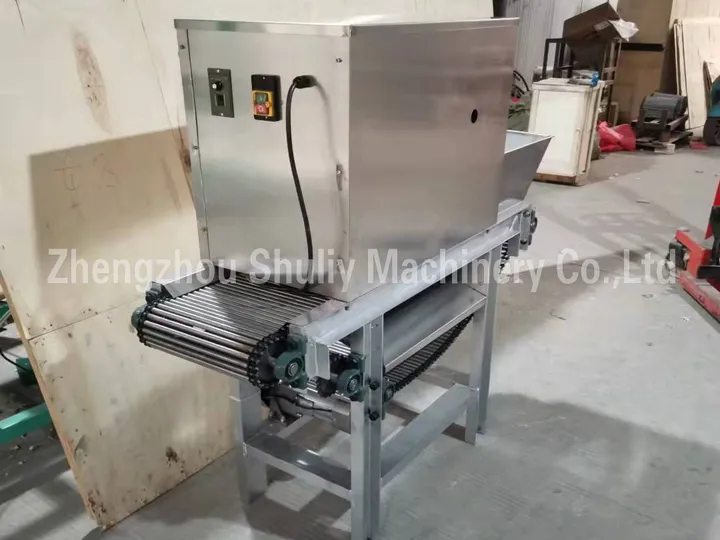
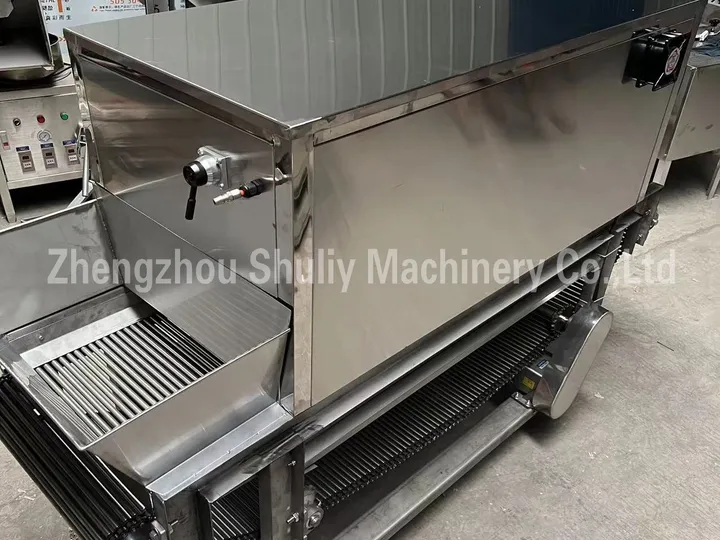
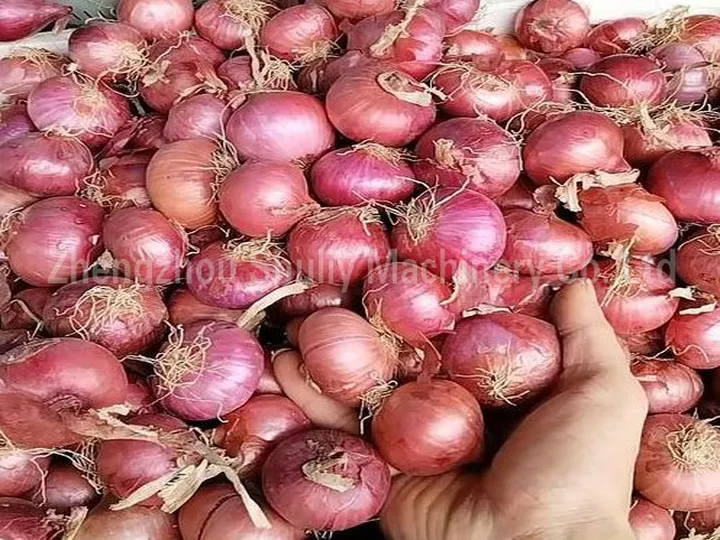
A chain-type onion peeling machine is best suited for processing a batch of onions with a diameter variation of no more than 5 cm. Larger size gaps cause uneven peeling and damage. If your raw onions vary widely, add a grading step before peeling.
3. Match Voltage and Power
Check your factory supply. Most industrial onion peelers support:
- 110V
- 220V
- 380 V
Power ranges from 1100W on the SL-200 to 3000W on the SL-1000. Confirm your electrical panel can handle the load. Custom voltage is available for special markets.
4. Measure Your Available Floor Space
The SL-200 needs about 130×55×140 cm. The SL-1000 needs 280×98×170 cm. Leave extra space around the machine for feeding, discharge, and maintenance access.
5. Consider Your Onion Variety
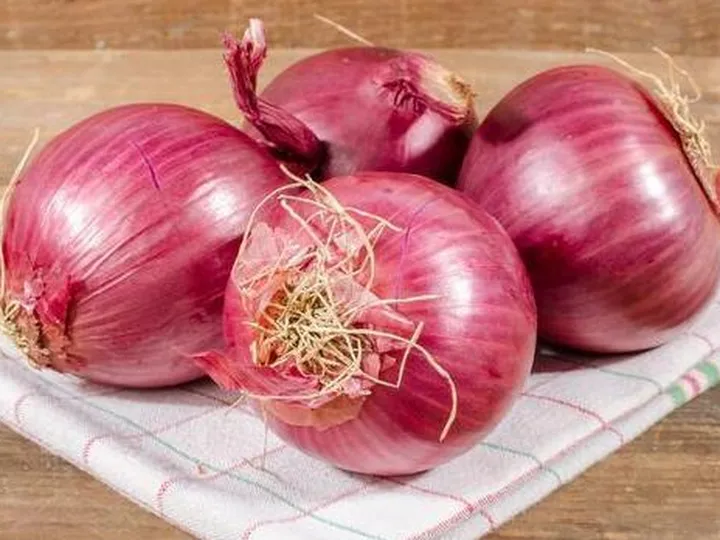
Yellow, red, and white onions have different skin thickness. Thin, papery skins peel easily with standard airflow. Thicker skins may need higher air pressure or slower chain speed. Tell your supplier your main variety before ordering.
6. Set a Realistic Budget
Price depends on capacity, voltage, customization, and shipping. A larger machine costs more upfront but lowers labor cost per kilogram. Ask for total cost of ownership, not just the purchase price.
7. Check After-Sales Support
A reliable supplier offers installation guidance, spare parts, and technical support. Shuliy Machinery provides a Garantia de 1 ano, lifetime support, and multilingual service.
Model Comparison: SL-200 vs SL-400 vs SL-600 vs SL-1000
| Feature | SL-200 | SL-400 | SL-600 | SL-1000 |
|---|---|---|---|---|
| Saída | 200 kg/h | 400 kg/h | 600 kg/h | 1000 kg/h |
| Poder | 1100 W | 1200W | 1500 W | 3000W |
| Qual é o princípio de funcionamento da máquina de limpeza de alho SL-800? | 130×55×140 cm | 162×55×140 cm | 182×60×140 cm | 280×98×170 cm |
| Peso | 150 kg | 250 kg | 350 kg | 500 kg |
| Rotating Rollers | No | No | Yes | Yes |
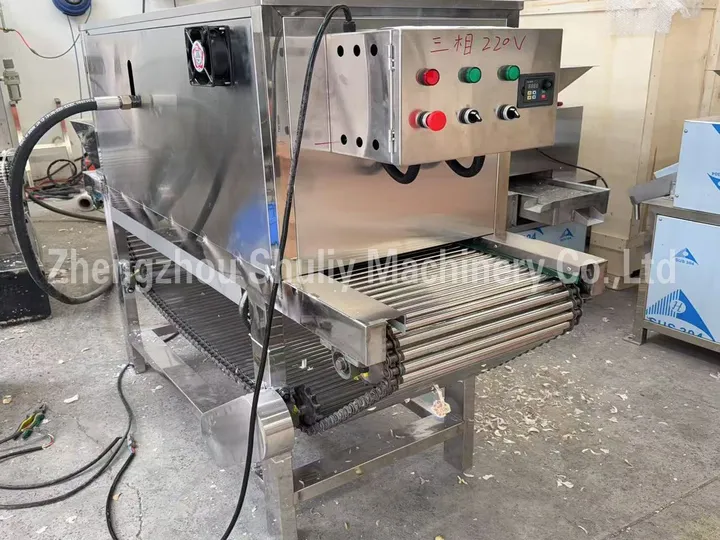
The SL-600 and SL-1000 use rotating rollers. This improves peeling on larger onions and higher-volume lines. The SL-200 and SL-400 use fixed rollers and suit smaller budgets.
Key Features to Consider in an Onion Peeling Machine
When comparing machines, prioritize these features:
- Dry pneumatic peeling. No water means less waste and lower spoilage risk.
- SUS304 stainless steel. Resists corrosion and cleans easily.
- Adjustable chain speed. Match feeding rate to your upstream supply.
- Rotating rollers on 600+ models. Better for large onions and high output.
- Wide voltage range. Easier installation in different countries.
Common Mistakes to Avoid
Buying Too Small
Some buyers choose the cheapest model to save money. Soon, demand exceeds capacity. Upgrading costs more than buying the right size first.
Mixing Onion Sizes Without Grading
This causes poor peeling quality. Always pre-sort or grade onions before loading the machine.
Ignoring Voltage Requirements
A voltage mismatch causes installation delays and extra electrical work. Confirm power supply before purchase.
Neglecting Maintenance
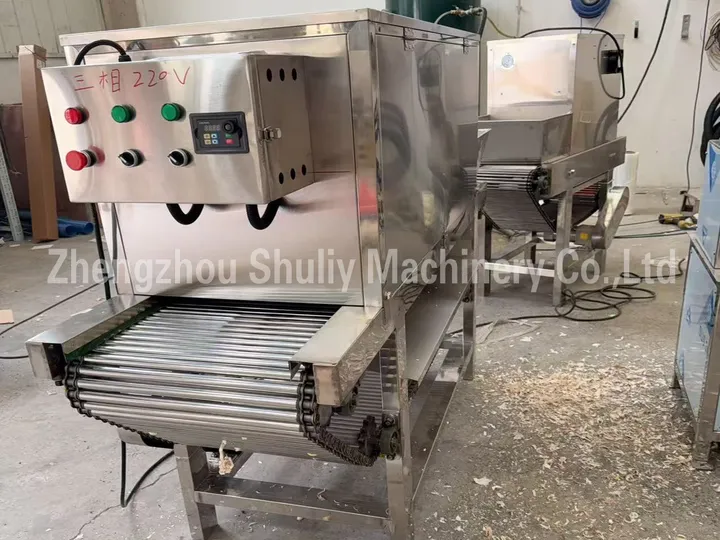
Even a durable commercial onion peeling machine needs regular cleaning and chain lubrication. Factor maintenance time into your workflow.
When Should You Upgrade?
Consider moving to a continuous onion peeling machine if you notice:
- Workers cannot keep up with peeling demand.
- Product quality varies between shifts.
- Labor costs keep rising.
- You want to connect peeling to a full processing line.
- Orders are delayed because of slow prep.
What Should You Consider Before Buying a Continuous Onion Peeling Machine?
Use this checklist before you buy:
- Daily output target calculated
- Onion size range checked and within 5 cm per batch
- Factory voltage and power confirmed
- Floor space measured
- Onion variety matched to machine settings
- Budget includes shipping, installation, and spare parts
- Supplier support verified
Are You Looking For a Continuous Onion Peeling Machine?
Choosing the right continuous onion peeling machine means matching capacity, size handling, voltage, and budget to your real production needs. Manual peeling and small peelers work at low volume, but they limit growth and increase cost per kilogram.
If you process onions at scale, an automatic onion peeling machine gives you consistent quality, lower labor costs, and easier line integration. Compare the SL-200, SL-400, SL-600, and SL-1000 models, then contact Shuliy Machinery for a tailored quote.
Click the contact window on the right to get in touch with us. We will provide you with a quotation within 24 hours.